77° and Patchy rain nearby



Image
Courtesy of Misti Spillman, Manager, Preservation and Community Outreach Woodland Cemetery & Arboretum. Living here in Warren County, we are fortunate to be between the two larger cities of Dayton and Cincinnati. This allows us to not only share in both of these city's accomplishments, but in their residents. And, believe it or not, one way of learning about these people can often be found in historical cemeteries. Dayton, Ohio's Woodland Cemetery and Arboretum, which is one of the oldest garden cemeteries in the United States, is filled with history. And, this February the WarrenCountyPost.com has been given the privilege to publish a piece from Woodland Cemetery and Arboretum about
Dayton’s first “graveyard” was located at the northeast corner of Main and Third Streets (where the Callahan Building stands today). Acting as proprietor of the town, Daniel C. Cooper had donated two lots for use by the Presbyterian Church in 1799[1].
As was the custom of the day, the ground adjacent to the church was used for burials.
Fewer than ten years later, it became clear that at the rate Dayton was expanding, it would soon outgrow its first cemetery.
In response, Mr. Cooper “donated to the Presbyterian & Methodist churches, and the town, for a graveyard, four acres of ground on the south side of Fifth Street, between Ludlow and Wilkinson streets,[2]” in 1805. Readers who are able to picture the location described above may be able to guess what happened next.
Once again, the growing city began to creep ever closer to the cemetery’s boundary. By 1840, it was obvious to John W. Van Cleve that something needed to be done.
“Mr. Van Cleve was no ordinary man. Endowed with a vigorous intellect he had improved it by diligent study. Few men have cultivated so wide a field of knowledge, and yet few were so thorough in each department. A geologist, botanist, engineer, musician, painter, and engraver of no mean skill, he yet found time for the widest reading, and possessed of a most retentive memory, there were few subjects with which he was not familiar. [3]”
Van Cleve’s solution was the establishment of a “rural cemetery”—a new type of cemetery that was growing popular during the mid-19th century. Unlike earlier graveyards, which were typically attached to a church & nestled within the communities they served, a ‘rural’ or ‘garden’ cemetery was intentionally placed outside of the city limits. This approach solved two different problems: moving burial grounds to a less populated part of town reduced anxiety about health concerns, as well as freeing up more downtown real estate for homes and businesses.
Determined to avoid the need to relocate Dayton’s deceased ever again, Van Cleve searched for a suitable location.
About a mile south of town, a farmer named Augustus George owned a large tract of hilly land which was not yet cleared of timber. He was willing to sell forty acres of it, at $60 per acre.
Van Cleve calculated that in order to purchase the land & turn it into a functioning cemetery, he was going to need to find at least 50 people who were willing to invest $100 into the project. He found 52. Their first meeting was held on a Thursday evening in February of 1841, and the Woodland Cemetery Association was born.
Robert C. Schenck (before his time as a Union army General) was elected secretary, David Z. Peirce as treasurer. The first trustees included Job Haines, James Perrine, Edward W. Davies, and J. D. Phillips. At a subsequent meeting of those trustees, John W. Van Cleve was elected the first president of the Woodland Cemetery Association—a position he treasured until his death in 1858.
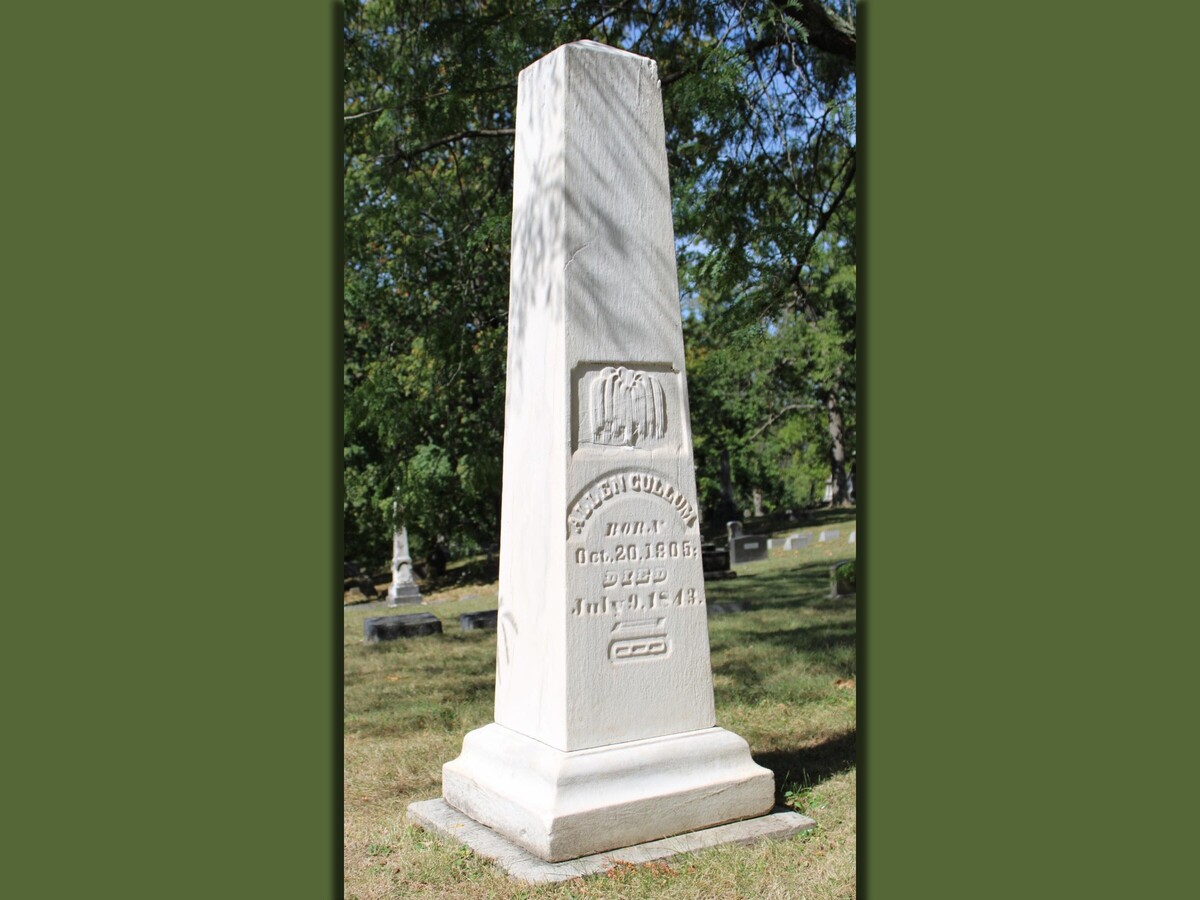
On the 7th day of June, 1843, the cemetery was opened, and burial plots offered to the public for sale. Allen Cullum became the first person to be buried at Woodland Cemetery on July 11th of the same year.
But what about the old cemeteries?
“Woodland Cemetery having been established, in 1849 the city bought a "potter's field" just south of the cemetery, and subsequently, by ordinance, prohibited further burials in the graveyard. The reversionary interest of the Cooper heirs having been purchased, the ground was laid out in building lots and sold, realizing a handsome sum for the churches and the city. The remains of the dead were carefully disinterred, and decently buried in Woodland Cemetery and potter's field. [4]”
Some notable re-burials at Woodland include David Zeigler (the first mayor of Cincinnati) in section 65, lot 4, and Zeigler’s wife, Lucy Ann in section 55, lot 1. Nearby are Sophia Cooper, Daniel Cooper's widow, and Gen. Fielding Lowry, whom Sophia married after Daniel's death in 1818. Daniel C. Cooper himself is buried in section 55, lot 1. The grave of Revolutionary War Colonel John Grimes was moved to Woodland Cemetery in 1855.

Overcast, with a high of 80 and low of 64 degrees. Overcast during the morning, patchy rain nearby for the afternoon and evening, clear overnight.