61° and Mist
Image
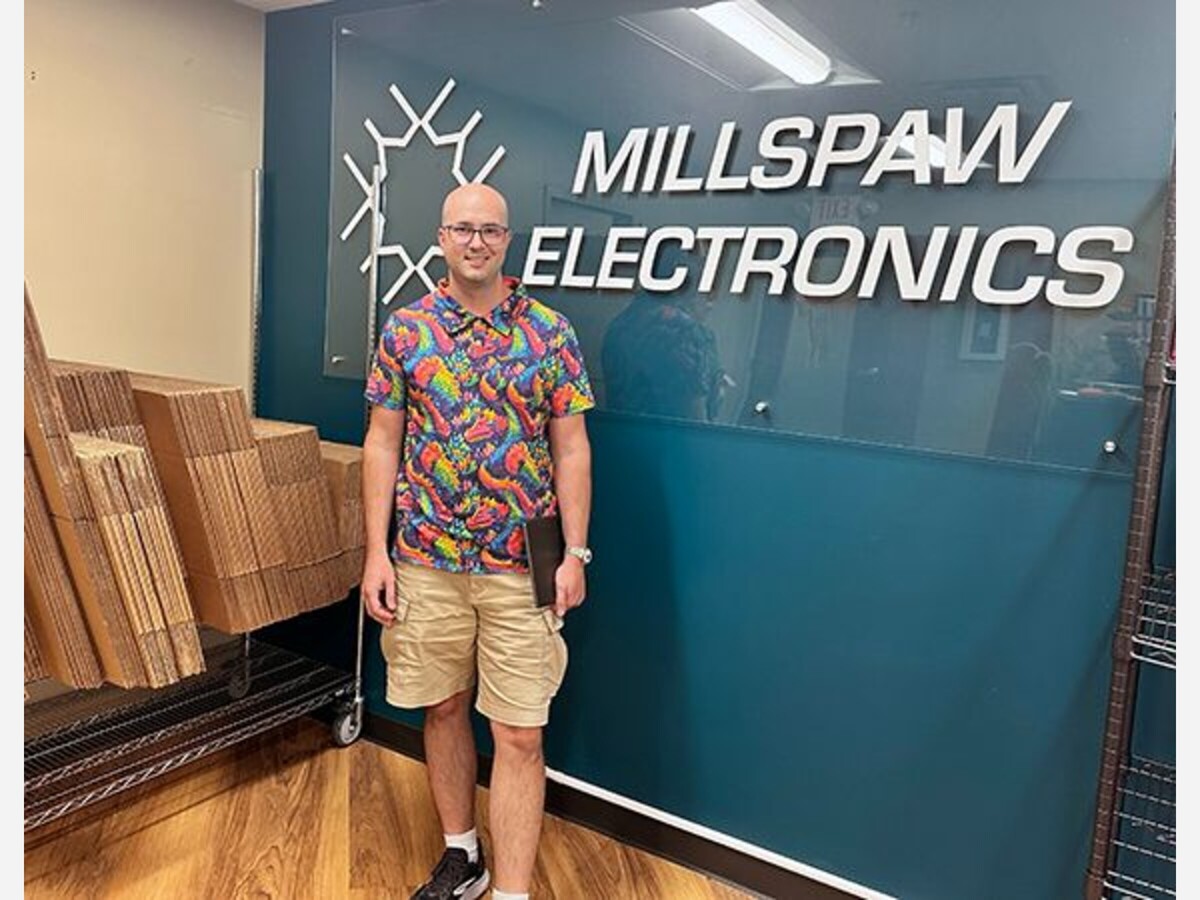
Samuel Millspaw of Millspaw Electronics



MASON, OH — When Samuel Millspaw started Millspaw Electronics in 2019, he pictured himself working with circuit boards, power supplies and other electronic components. He did not necessarily picture himself helping solve problems for nuclear power plants across the United States.
“I didn’t envision in 2019, when I formed the company, the full direction that it would go,” Millspaw said. “It took off in a rather unexpected direction.”
It was a direction Millspaw decided to follow.
Today, the Mason-based engineering company employs more than 30 people, supports more than half of the commercial nuclear power plants in the United States and was ranked No. 2 among engineering companies on the 2026 Inc. 5000 list of fastest-growing private companies.
The company reported 756% revenue growth from 2022 through 2025 and ranked No. 457 overall on the Inc. 5000. And Millspaw believes the company's growth may only be beginning.
Over the next two to three years, he said, Millspaw Electronics could add somewhere between 40 to 200 jobs as the company expands its ability to serve the nuclear power industry.
“I expect us to continue to grow at a phenomenal rate,” Millspaw said.
Millspaw did not grow up in Warren County. He was raised in western New York and attended Gannon University in Erie, Pennsylvania, where he studied electrical engineering.
His wife’s family is from the west side of Cincinnati, and in 2019 the couple decided they wanted to put down roots near family and raise their children close to their grandparents.
Millspaw accepted a position with a startup company in Mason and moved to the area. Coincidentally, he worked in the same Mason Tech Elevator building where his own company would later grow.
At first, Millspaw Electronics was simply a side business that allowed him to take on occasional engineering consulting work. Then, COVID-19 changed things.
Millspaw was working for a medical-device startup when projects began slowing or being placed on hold. Looking for more work, he resigned and made Millspaw Electronics his full-time business at the beginning of 2021.
By 2022, he began shifting the company from general engineering consulting toward a service-based business— helping nuclear power plants deal with obsolete equipment.
“There were problems there to be solved,” Millspaw said.
Nuclear plants have long operating lives, and some still rely on electrical and electronic equipment dating to the 1970s and 1980s. That does not necessarily mean the equipment needs to be replaced. In some cases, Millspaw said, the older analog technology remains dependable, maintainable and free from some of the cybersecurity concerns associated with newer digital equipment.
The challenge comes when the original manufacturer stops producing or supporting it. And, that is where Millspaw Electronics comes in.
The company repairs and refurbishes existing equipment, reverse-engineers replacement components and manufactures like-for-like replacements when original parts are no longer available. It also works with newer commercially available components and determines whether they can meet nuclear-industry quality requirements.
The company has established a nuclear quality assurance program aligned with ASME NQA-1 and federal requirements under 10 CFR 50 Appendix B, standards governing the design, procurement, testing, inspection and documentation of equipment used in nuclear applications.
Some of the equipment that arrives at the Mason facility can be as small as a circuit board. Other pieces can weigh hundreds of pounds.
“It’s not just the reactor itself,” Millspaw said of a nuclear plant. “You’ve got all of the electrical components and different levels that all work together.”
Most projects can be handled at the company's Mason facility. When a plant does not have a spare component available to send to Millspaw Electronics, engineers may travel to the plant to service the equipment or collect the specifications necessary to reproduce it.
For the first few years, Millspaw was essentially the company.
“It was only me up until mid-2022,” he said.
He then hired his first engineer, followed by additional employees as the workload increased. A major turning point came in 2024 when the company's nuclear quality assurance program was audited and accepted for industry work.
“That allowed us to really address that market, and the nuclear sector took off for us from there,” Millspaw said.
From a team of about five or six employees at that point, the company has grown to more than 30. Millspaw credits much of that growth to his employees.
“We have a brilliant team, and that has been instrumental in our success,” he said.
More than half of the company's employees are from the local area as the company has attracted workers who grew up or attended school in southwest Ohio and wanted an opportunity to return. Others have relocated from farther away, including internationally, for the chance to work on specialized engineering problems.
Millspaw said Mason has turned out to be an ideal place to grow the business because of the area's pool of engineering and technical talent.
“There is a lot of engineering expertise, a lot of really bright people,” he said.
Millspaw Electronics' physical footprint has also expanded along with its workforce. When Millspaw first began operating from the Mason Tech Elevator, his company occupied only a small portion of the building. He credits the building's management with helping the company expand as its needs changed.
“The landlord of this building has really been more of a partner than a landlord,” Millspaw said.
Walls have moved, offices have been added and the company's footprint has continued growing. Eventually, however, Millspaw expects the company will outgrow its current setup.
Over the next several years, he expects Millspaw Electronics will need additional warehouse and laboratory space as it begins working with larger equipment. Currently, the company can generally handle equipment up to about pallet size.
But nuclear power plants contain much larger systems — sometimes equipment as large as a truck — that face many of the same problems Millspaw Electronics is already solving on a smaller scale.
“Three years from now, I expect that we will have expanded within this building with the support of the Tech Elevator,” Millspaw said, “but that we'll be looking for a permanent location to move into that has expanded warehousing and laboratory capability.”
Millspaw also sees opportunity in renewed interest in nuclear energy. Several nuclear plants that were previously shut down for economic reasons are now being considered for restart as electricity demand grows, he said.
Part of that demand is coming from the rapid expansion of artificial intelligence and data centers, which require enormous amounts of electricity. Nuclear power companies have announced agreements with large technology companies to help meet those growing needs, while interest has also increased in new-generation technologies such as small modular reactors.
Millspaw cautioned that new nuclear projects take considerable time to approve and build. Still, he is optimistic.
“There is a lot of momentum, and I believe that the nuclear industry looks great,” he said.
That growth could mean even more demand for the kind of aftermarket engineering work Millspaw Electronics provides.
The company's growth has also changed Millspaw's own job. For years, he was simultaneously the engineer, business owner and problem solver. As the company expanded, that became increasingly difficult.
“It was around mid last year that the team developed to the point that they finally pushed me out of the hands-on engineering space so that I could focus on running and developing the business,” he said.
While he admits to occasionally missing the hands-on engineering work, Millspaw said he enjoys his new role. And he believes the company's culture is as important to its future as its technical expertise.
Millspaw describes the company's three core principles as:
The “people first” philosophy, he said, means creating an environment where employees can succeed professionally without sacrificing their lives outside of work.
“We try to fill people's cups,” Millspaw said.
When employees feel supported, he believes that benefit extends beyond the workplace.
“They take that into their communities and are more equipped to give back,” he said. “It benefits the business. It benefits the community. It benefits their lives.”
Being quality-driven means doing more than complying with strict nuclear regulations, he said. It means building something correctly and making it last.
And being solution-focused means listening to customers instead of trying to sell them a predetermined service.
“We listen to their needs,” Millspaw said. “We understand and put critical thought into the problems that they're facing and tailor the way that we do business to deliver something to them that fixes exactly what they're struggling with.”
For a company that began as one engineer taking on side projects, that approach has produced growth even Millspaw did not anticipate.
“I knew that there was space to grow, but I honestly didn't anticipate that it would grow to this size,” he said.
Now, as Millspaw Electronics looks toward potentially dozens — or even hundreds — of additional jobs and a larger permanent facility, Millspaw believes the company's rapid rise reflects something bigger than a favorable market.
“To grow as fast as we have,” he said, “I think it's because we are doing something unique and special.”


Mist, with a high of 63 and low of 58 degrees. Don't forget your umbrella! Mist for the morning, patchy rain nearby overnight.