Image
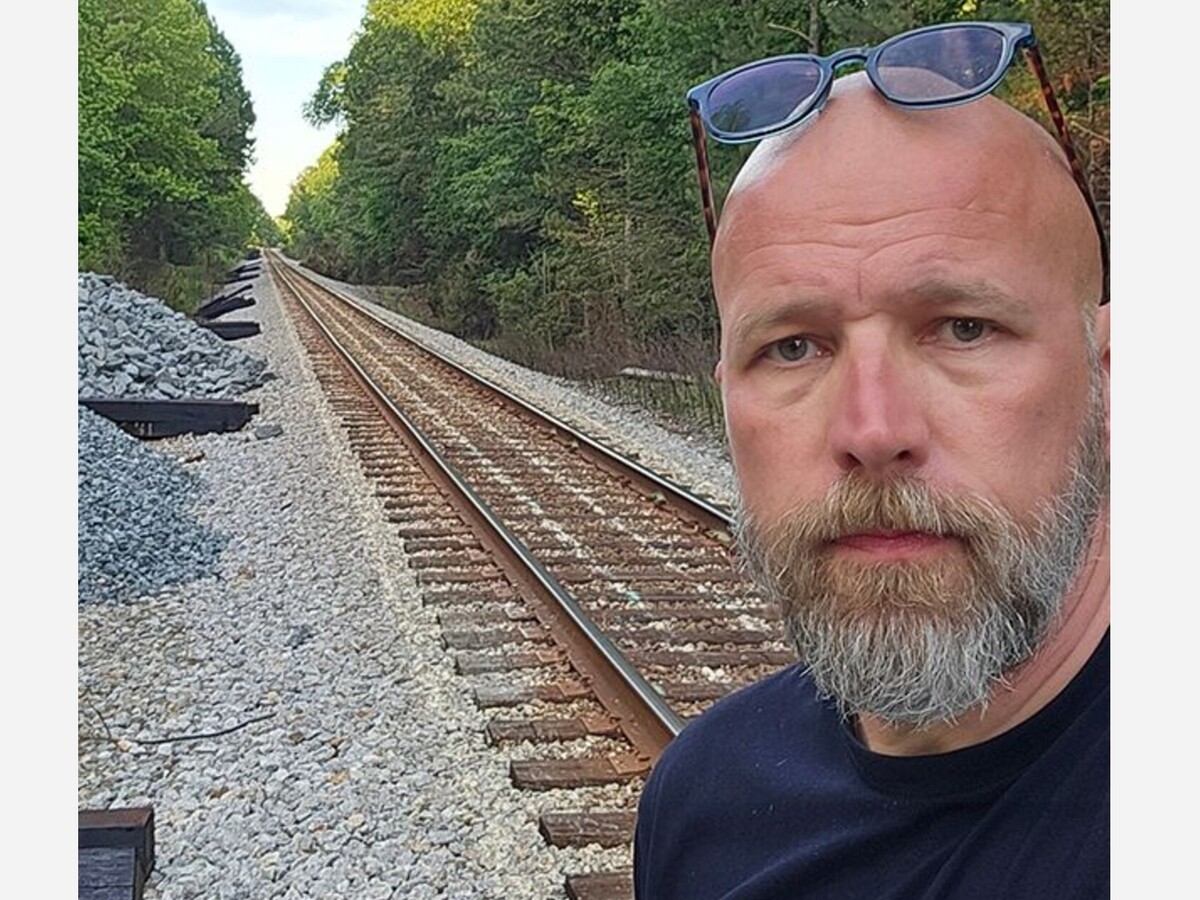
Rusty Groves at the site of the 1864 Battle of Resaca, Georgia, where he conducted field research into the Civil War service of his 3rd-great-grandfather.



Story and photos courtesy of Buckeye Genealogy & Research, LLC — The Grave Guy™
WARREN COUNTY, OH -- Rusty Groves will tell you that every dead end is just a story waiting for a different path. He has walked Civil War battlefields, pulled ledgers from county archives, and used historical aerial photographs to make the case for a lost cemetery a county had never officially recognized. Now he does it professionally. Buckeye Genealogy & Research, LLC — The Grave Guy™ — is open for business, serving clients in Clinton, Highland, Fayette, Greene, Warren and surrounding counties.
The Grave Guy™ specializes in cases that online searches cannot solve. The records that break open a dead-end case are often sitting in a county archive, rolled onto microfilm, or tucked inside a ledger that was never digitized. Groves goes after them.
The firm offers three levels of service:
Groves is available to work with individuals and families, historical organizations, and governmental and regulatory bodies across the United States, with most fieldwork concentrated in Ohio and the surrounding region.
Every engagement begins with The Grave Survey, a free intake form at thegraveguy.com, followed by a complimentary 20-minute Case Review and a clear, written proposal with all fees and retainer terms listed before work begins.
“I approach every inquiry as a unique case,” Groves said. “Partial dates, family rumors, and ‘what grandma said’ are often where the truth hides.”
Case files, such as family submissions and research findings, are treated as confidential. Personal details and identifying photographs are never published on the firm’s blog, Stories UnEarthed, without the client’s explicit written permission. General research patterns and methods may be shared for educational purposes, with all identifying details removed.
The firm’s most visible recent work began with a personal question: Where was Groves’ 4th great- grandfather, William Suttles of Vernon Township, buried? That search led him to the original handwritten registers of the Clinton County Infirmary — first transcribed by volunteers at the Clinton County Genealogical Society beginning in 2011 — documenting men, women, and children buried on the infirmary farm between 1840 and 1902.
Renewed interest sparked by Groves’ family search prompted a fresh review of the registers in 2025 and 2026. CCGS volunteers revised the documented count from 216 to at least 250 burials. Groves logged more than 175 hours of independent investigation on top of that foundation and presented his research in person to the Clinton County Board of Commissioners in February 2026.
Following that presentation, the commissioners authorized a $15,000 archival and mapping study by Gray & Pape Heritage Management to help define the cemetery’s boundaries. Groves. subsequently provided an independent Executive Summary documenting his six-month investigation to the commissioners, the Clinton County Engineer’s Office, and the Clinton County History Center.
The Gray & Pape study is ongoing. Clinton County’s GIS cemetery map currently documents 89 burial sites across the county. When this project concludes and the Infirmary Cemetery receives official recognition, it will become the 90th.
Among the documented burials are at least two military veterans. The first is Walter (Barton) Roberts, a Revolutionary War veteran from Maryland whose service Groves is still researching. The second is George Wright, an Irish immigrant who served in the Ohio Militia during the War of 1812 and died at the Infirmary in 1857 at age 98.
Wright’s War of 1812 service entitled him to two federal land warrants in Illinois, secured in the 1850s with the assistance of a Wilmington attorney who also edited the local newspaper. Wright assigned those warrants to Clinton County to help offset the cost of his care at the Infirmary.
That same editor later wrote Wright’s obituary, which states that he also served in the Revolutionary War and voted for George Washington twice. The presence of these men matters all the more as America approaches its 250th anniversary.
Groves is writing and self-publishing a full-length history of the infirmary titled "The Obscure Lot." The book traces the institution from its founding in 1835 to its closing in 1989 — a history that touched nearly 3,000 lives, yet left at least 250 of them buried in a cemetery the county had never officially recognized. It follows the elected officials, court officers, charity workers, church leaders, and state and federal agencies whose decisions shaped their lives and determined how they were remembered. Archival access and post-publication support are provided by the Clinton County History Center.
Some of the records Groves needs were handwritten 150 years ago in penmanship no computer can read. New AI tools are starting to change that. AI-powered Handwritten Text Recognition (HTR) allows him to transcribe — with improving degrees of accuracy — aged county ledgers, military records, and court documents that standard search engines cannot read.
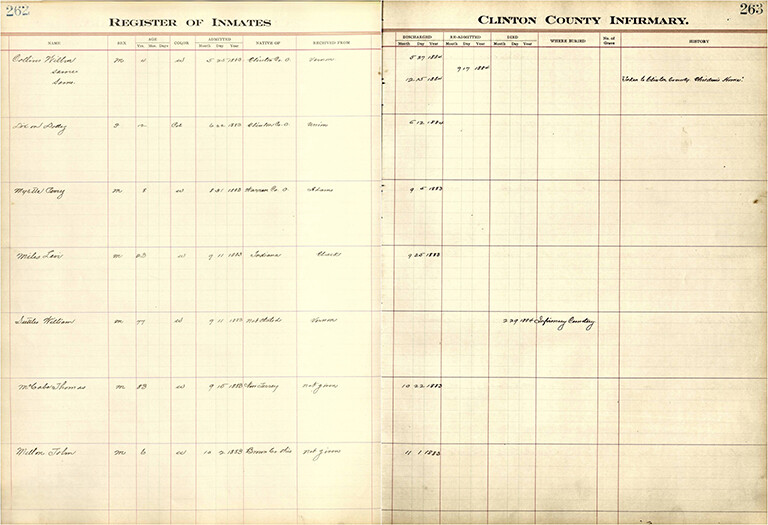 Two combined pages from the Clinton County Infirmary Register of Inmates, showing the entry for William Suttles — Rusty Groves' 4th-great-grandfather — admitted September 11, 1883, and recorded as having died on February 29, 1884 and buried in the Infirmary Cemetery. The same page records the admissions of a four-year-old child, a twelve-year-old girl, a twenty-three-year-old man, and others into their eighties — a snapshot of who the Infirmary housed across the full range of age and circumstance. The register, held at the Clinton County Records and Archives, is among the primary sources driving the effort to locate and protect the burial ground. Photo courtesy of Rusty Groves / Clinton County Records and Archives.
AI also helps Groves move through large document sets quickly — analyzing and synthesizing records to surface family connections, social and civic roles, business histories and patterns across multiple archives that would take weeks to identify by hand. As a registered researcher with the National Archives and Records Administration (NARA), he can remotely request federal records collections unavailable through commercial genealogy platforms. He also partners with a network of independent researchers for on-site record retrievals.
“AI handles the volume,” Groves said. “I focus on the evidence that actually matters.”
Groves spent more than 30 years in technology and regulatory compliance before turning those same skills toward historical investigation. That work demands the same careful reading, precision, and attention to detail that genealogical research requires at the highest level.
He has photographed more than 2,000 gravestones for Find a Grave. He also worked with the U.S. Department of Veterans Affairs to secure a family memorial marker for his 3rd greatgrandfather — a Civil War soldier whose grave was lost among the battlefield dead at Resaca, Georgia, and whose father, William Suttles, lies among the unmarked burials at the heart of the infirmary project.
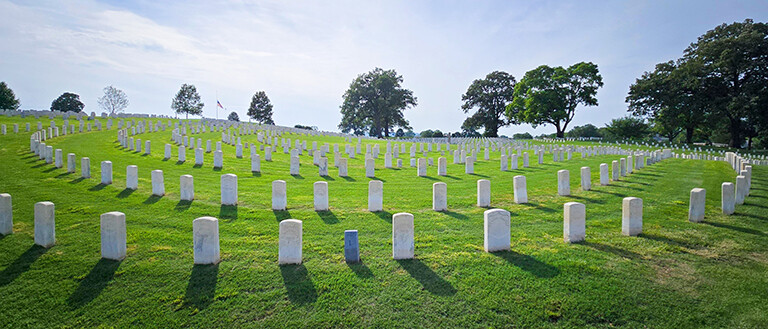 Section L at Chattanooga National Cemetery, Tennessee, where Rusty Groves walked among the graves of soldiers from his 3rd-greatgrandfather's regiment — the 31st Ohio Infantry — while searching for the burial site of Samuel B. Suttles, killed in action in 1864 and believed reinterred at Chattanooga among the unknowns. The gray marker in the foreground identifies the section. Photo courtesy of Rusty Groves.
Groves explained that the work is personal for another reason. A search for his own biological father — assisted by a volunteer search angel working in CeCe Moore’s genetic genealogy network — ultimately ended with the answer he had long been seeking. No dead end, he learned, is truly final.
“I’ve lived this work,” Groves said. “Every grave has a story waiting to be told. My job is to go find it.”

Sunny, with a high of 64 and low of 40 degrees. Sunny in the morning, clear in the afternoon and evening,