56° and Clear
Image
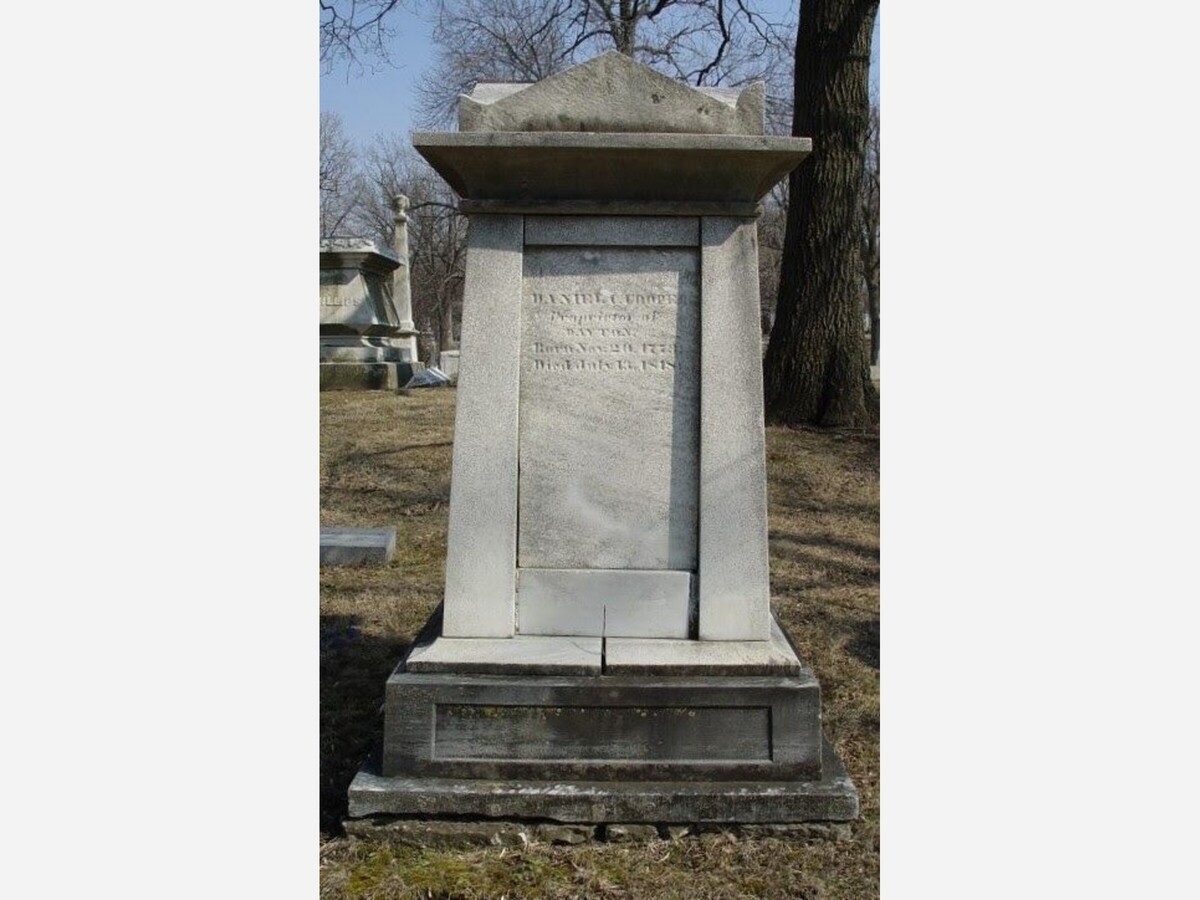
(Source: Woodland Cemetery and Arboretum) Daniel Cooper's Gravestone



Courtesy of Misti Spillman, Manager, Preservation and Community Outreach Woodland Cemetery & Arboretum. Living here in Warren County, we are fortunate to be between the two larger cities of Dayton and Cincinnati. This allows us to not only share in both of these city's accomplishments, but in their residents. And, believe it or not, one way of learning about these people can often be found in historical cemeteries. Dayton, Ohio's Woodland Cemetery and Arboretum, which is one of the oldest garden cemeteries in the United States, is filled with history. And, this February the WarrenCountyPost.com has been given the privilege to publish a piece from Woodland Cemetery and Arboretum about Daniel C. Cooper.
Born in the Passaic Valley, New Jersey, Daniel C. Cooper was the son of Margaret Lafferty & George Cooper, a wealthy farmer.
In late 1795, Judge John Cleves Symmes (a land speculator from New Jersey), sold Arthur St. Clair (Governor of the Northwest Territory), General James Wilkinson, Israel Ludlow and Jonathan Dayton (a New Jersey Congressman), the land that became known as the "Dayton Purchase." Daniel C. Cooper, now 20 years old and educated as a surveyor, was hired by Jonathan Dayton to go west to Fort Washington, Ohio to look after the Congressman’s interests.
Ludlow named the village after his friend Jonathan Dayton (who ironically never set foot in the town) and laid out the streets, which at four poles wide (or 66 feet) were big enough to allow a coach led by 4 horses to turn around—or, as they would have said; "turn a coach and four."
Daniel Cooper headed the team that surveyed the land and laid out the town site in 1795, settling permanently in Dayton in the summer of 1796.
Later on, Judge Symmes failed to meet his financial obligations to the federal government. In response, the government offered to sell the land to Dayton’s residents at the rate of $2.00 an acre. This was not a small amount of money to Dayton’s earliest settlers—it was more than they had already paid to Symmes. By the time the matter was settled in 1802, only five families remained in Dayton.
Daniel Cooper brought the town’s concerns before the United States Congress. It wouldn’t be right, he said, to turn out these settlers after they had worked so hard to clear the land and build homes. In the end, Cooper paid the federal asking price of $2 per acre. He purchased more than 3000 acres—including fledgling Dayton, and he was named proprietor of the town by the government.
Using the original survey, Cooper replatted the town with minimal alterations. Clear titles were passed to the original settlers. In addition, Cooper donated land for two churches, a cemetery and the block bordered by Third, St. Clair and Second Streets for use as a town common. He also donated the property at the corner of Third and Main Streets so that a county courthouse could be built.
Politically active from the time he became Dayton’s proprietor, Daniel C. Cooper represented Montgomery County in the Ohio General Assembly multiple times. He also operated of a variety of mills.
At the time of his death, Daniel Cooper was 45 years old and a prominent citizen of Dayton. He had a beautiful wife and a 6-year-old son, who, like much of the city, were stunned and heartbroken by his loss.
Daytonians who remember their local history lore may recognize the following story, written by Roz Young for the Dayton Daily News in 1994:
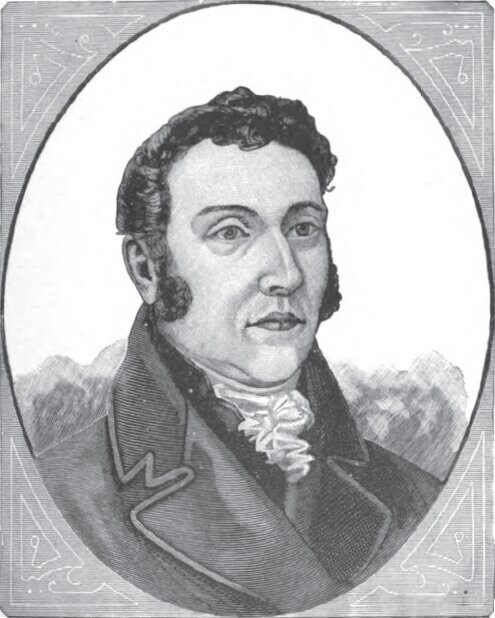 (Source: History of the city of Dayton and Montgomery County, Ohio by Augustus Waldo Drury, 1909.) Daniel C. Cooper (1773 - 1818)
 “On the morning of July 13, 1818, [Horatio G.] Phillips walked to Cooper's house. "The church bell was delivered to my place this morning," he said. […]
[Cooper] fetched a wheelbarrow from his barn and pushed it to the store on the southeast corner of Second and Main. He set the wheelbarrow down by the bell where it rested on the gravel street.
It never occurred to him to ask Phillips to help him load the bell on the wagon. It was heavy, and he tugged and pulled and strained to hoist it into the barrow. The veins on his forehead head stood out as the blood rushed through them as he struggled. Finally with the bell in the wheelbarrow, he started for the church.
He started down Second Street, but before he had gone very far, his hands lost their grasp on the barrow handles and he fell over in the street.
Daniel Cooper was dead. A blood vessel in his brain had burst. […]”
But was one of Dayton’s founders truly killed by a bell? A diary entry written by Dr. Job Haines, one of Dayton’s first physicians, tells us that:
“Mr. D.C. Cooper, after a severe illness of about six weeks, died about midnight between the 13th and 14th.” On the morning of July 13, 1818, [Horatio G.] Phillips walked to Cooper's house. "The church bell was delivered to my place this morning," he said. […]
[Cooper] fetched a wheelbarrow from his barn and pushed it to the store on the southeast corner of Second and Main. He set the wheelbarrow down by the bell where it rested on the gravel street. It never occurred to him to ask Phillips to help him load the bell on the wagon. It was heavy, and he tugged and pulled and strained to hoist it into the barrow. The veins on his forehead head stood out as the blood rushed through them as he struggled. Finally with the bell in the wheelbarrow, he started for the church.
He started down Second Street, but before he had gone very far, his hands lost their grasp on the barrow handles and he fell over in the street.
Daniel Cooper was dead. A blood vessel in his brain had burst. […]”
But was one of Dayton’s founders truly killed by a bell? A diary entry written by Dr. Job Haines, one of Dayton’s first physicians, tells us that: “Mr. D.C. Cooper, after a severe illness of about six weeks, died about midnight between the 13th and 14th.”
Whatever evidence there ever was has probably long been lost to time. Maybe Cooper’s death was caused by an unnamed illness, maybe by overexertion causing a blood vessel to burst in his brain. Perhaps the truth is somewhere in the middle, and Cooper, while more ill than anybody knew, really did overdo it to move a bell, which hastened his death.
Either way, the grave of Daniel Cooper, benefactor & proprietor of Dayton, was relocated to Woodland Cemetery in 1844. He & his family rest in section 55, lot 1.
Source: History of the city of Dayton and Montgomery County, Ohio by Augustus Waldo Drury, 1909.
Daniel Cooper’s Gravestone


Sunny, with a high of 70 and low of 48 degrees. Sunny during the morning, clear during the afternoon and evening,