62° and Light rain
Image



MASON, OH -- State Representatives Adam Mathews (R-Lebanon) and David Thomas (R-Jefferson) held a press conference on Tuesday in Mason. The conference was on recently enacted property tax reform measures championed by House Republicans.
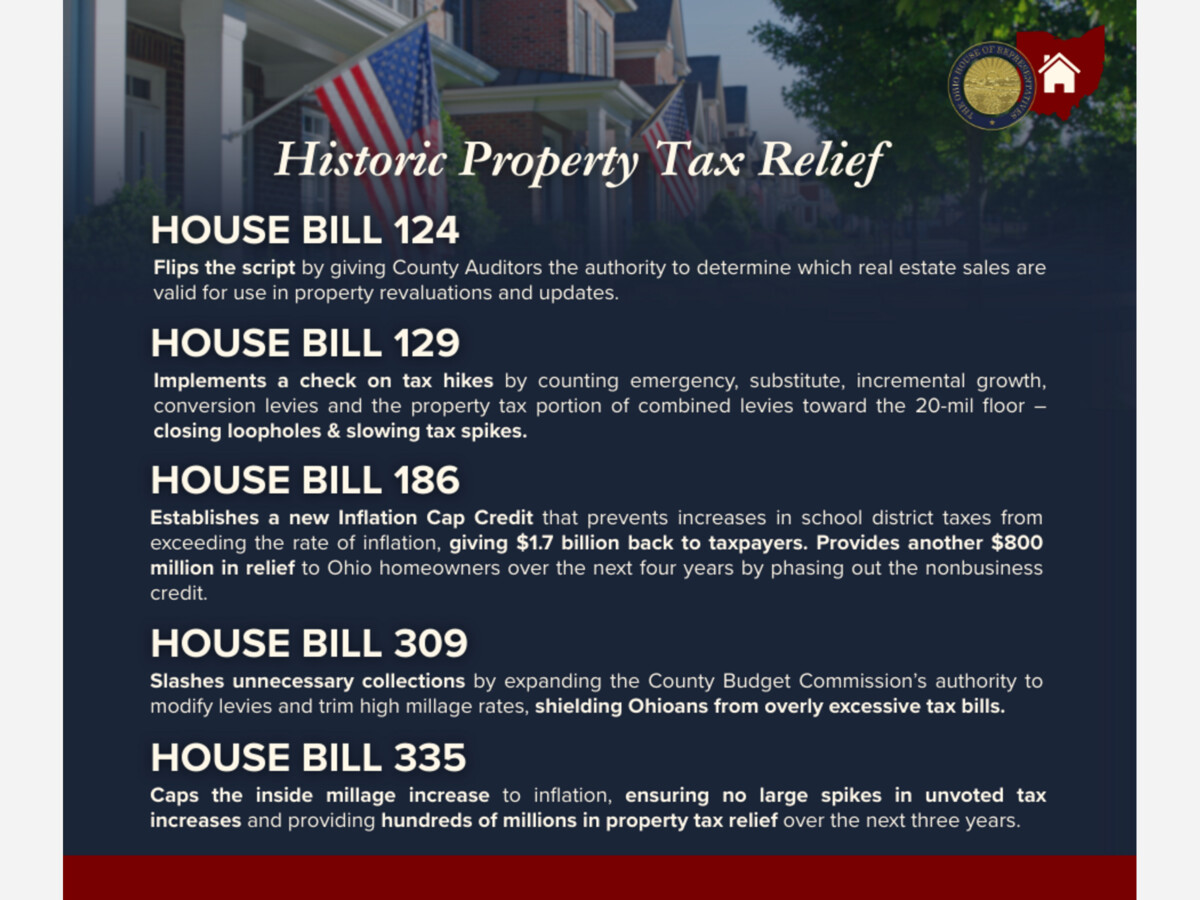
Mathews and Thomas explained that House Bills 129, 309, 186, and 335 work to curb spikes and provide direct property tax relief to Ohioans, totaling more than $3 billion in savings.
“I want to thank Mayors Messer and Styrcula for stepping up to reduce the impact of rising property taxes on their communities,” said Mathews. “With the additional tools offered to local communities following action by the Ohio General Assembly, local leaders are empowered to make the best informed decisions they can to balance the needs of local government while keeping the burden of property taxes as low as possible.”
“I’m excited to join Representative Mathews to highlight some of the positive steps that governments are doing in response to their taxpayers’ frustrations,” said Thomas. “I also wanted to take this opportunity to remind our taxpayers of the large reform changes to the property tax system we accomplished this past year. Had the legislature not acted Ohioans would have paid over 3.8 billion dollars more just in the next three years.”
Mathews and Thomas were joined by Mark Messer, Mayor of Lebanon, and Josh Styrcula, Mayor of Mason at the press conference.
Warren County residents are estimated to receive $39.3 million in tax relief for tax years 2025–2027 as a result of House Bill 186. Alongside this legislation, House Bill 335 will take effect in tax year 2027 in Warren County, providing further tax savings by capping inside millage.
Among the bills still being considered by the Ohio General Assembly is House Bill 443 sponsored by Mathews and Thomas. This legislation establishes clear, statewide protections that prevent counties from enforcing property tax foreclosure on homeowners when the occupant is 65 or older or is a qualifying surviving spouse. The bill applies to homes valued under $750,000 and ensures that the homeowner still makes some type of monthly payment toward any outstanding tax balance.
Across Ohio, many counties already use informal payment-plan practices to help seniors facing rising property taxes. House Bill 443 locks in a reliable, uniform process so older homeowners can enter payment agreements without the fear of losing lifelong homes.
According to Mathews and Thomas, as the Legislature continues broader work to address the state’s property tax challenges, this bill offers a focused, practical layer of protection for those making genuine efforts to pay their taxes.
Additional information on the enacted bills is below:
House Bill 186 saves Ohio property owners nearly $1.7 billion over the next three years by establishing a new Inflation Cap Credit that prevents increases in school district property taxes from exceeding the rate of inflation. The initiative also includes an appropriation holding Ohio school districts harmless for actual losses over this appraisal period compared to their current property tax collections, which will help schools that are not up for reappraisal or reevaluation this year offset any actual revenue losses.
This legislation will help protect homeowners from surprise hikes in their property tax bills when they live in a district that is on the 20-mill floor.
Members of the House also approved changes in the bill that would update the owner-occupied tax credit, a move that will provide more than $800 million in relief to Ohio homeowners over the next four years by phasing out the nonbusiness credit – except for agricultural property owners – and expanding the owner-occupancy tax credit.
House Bill 335 caps increases in inside millage collections to the rate of inflation. The bill requires county budget commissions to adjust the rate of each inside millage levy so that it does not grow by more than the sum of the three previous years of inflation. This happens during the county’s sexennial reappraisal or triennial update. The net effect of this provision totals between $621 million and $763 million in property tax relief over the next three years.
House Bill 129 implements a check on tax hikes by counting emergency, substitute, incremental growth, conversion levies and the property tax portion of combined levies toward the 20-mill floor – closing loopholes and slowing tax spikes. This measure ultimately lifts 237 districts off the 20-mill floor over the next four years.
The bill also provides a new alternative levy option. School districts with an existing emergency or substitute levy may renew these levies indefinitely as a “fixed sum levy.” The bill also allows schools on fiscal distress, as designated by the Auditor of State, or under a disaster declaration to levy a new one-time 5-year “fixed sum levy” to cover current expenses. These options provide additional flexibility for school districts.
House Bill 309 slashes unnecessary collections by expanding the County Budget Commission’s authority to modify levies and trim unnecessarily high millage rates, shielding Ohioans from overly excessive tax bills.
This package builds on the legislative work already accomplished by House Republicans to address property tax hikes in Ohio, including the state operating budget, which included multiple property tax reform provisions.
“While these are major and necessary reforms, more is needed,” Thomas added. “I remain committed to continuing to advance commonsense, pro-taxpayer solutions.”



Overcast, with a high of 70 and low of 58 degrees. Overcast during the morning, patchy rain nearby in the afternoon and evening, overcast overnight.